🌿
Sunday Feature: Agape Love in the Orthodox Faith — The Love That Transforms the World
Title
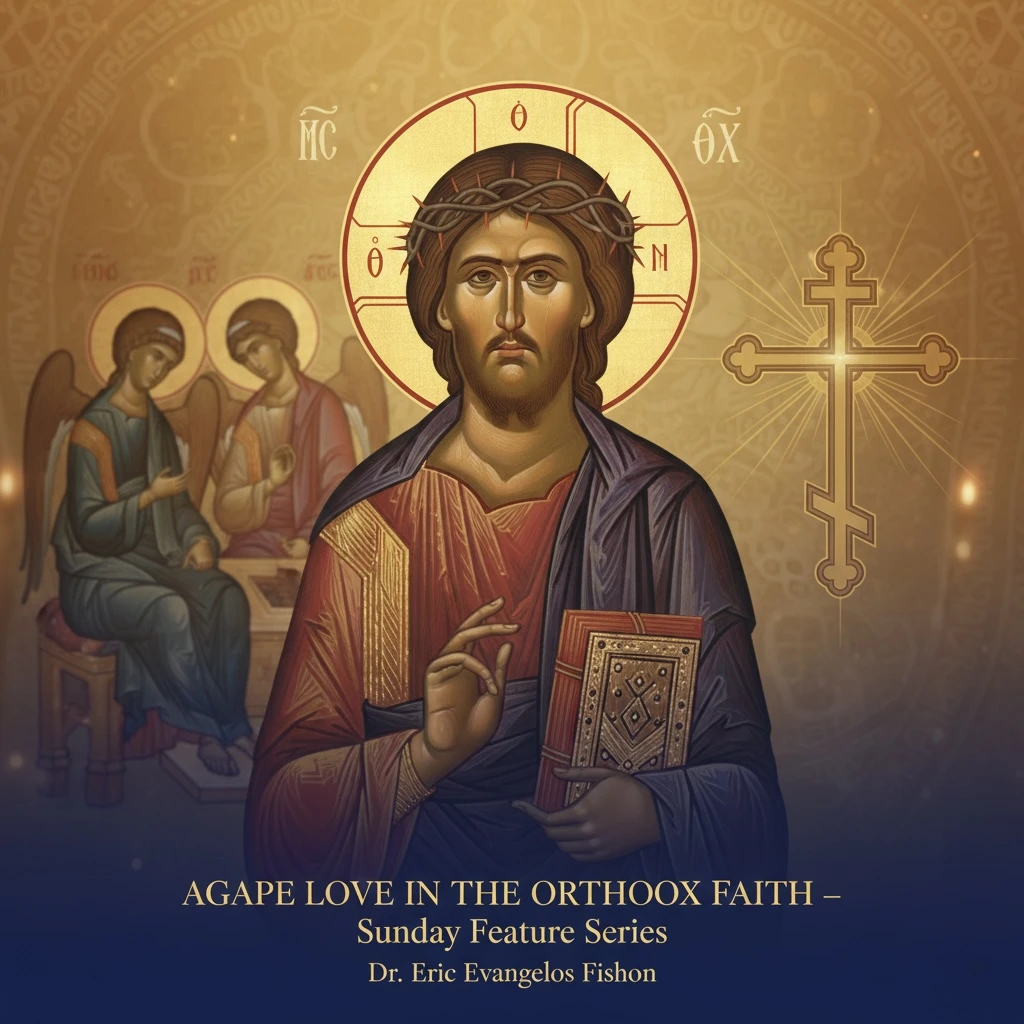
Agape—ἀγάπη—is one of the most sacred and transformative teachings of the Christian faith. In the Orthodox tradition, agape is not simply an emotion or a moral principle; it is the very life of God, poured out for creation. It is the love that forgives, heals, unites, and redeems.
As we enter this Sunday of reflection, the Church invites us to encounter agape as both a divine mystery and a daily practice, rooted in Scripture, shaped by the Fathers, expressed in the liturgy, and illuminated by modern voices who echo the Gospel—including Dr. Martin Luther King Jr., who famously preached that agape is the love that “seeks nothing in return” and “is the only force capable of transforming an enemy into a friend.”
✨
Orthodox Iconography: A Window Into Agape
Orthodox iconography offers visual theology—revealing truths that words cannot fully express. Several icons embody the depth of divine agape:
1. The Icon of the Bridegroom (Ὁ Νυμφίος)
Shows Christ during His passion—humble, crowned with thorns, yet radiating mercy.
This is agape that suffers willingly for the salvation of the world.
2. The Hospitality of Abraham (The Trinity Icon by St. Andrei Rublev)
Three angels seated at the table—the icon of divine communion.
Agape is shown as perfect unity, peace, and welcome.
3. The Crucifixion Icon
Christ stretched between heaven and earth, praying forgiveness over humanity.
This is the fullest revelation of sacrificial love.
These icons remind the faithful that agape is not abstract—it is incarnate, visible, and profoundly relational.
📖
Scriptural Foundations (Hyperlinked)
Agape appears throughout the New Testament, but several passages anchor its meaning:
“God is Love”
—
Agape is not something God has—it is who He is.
The Love Chapter
—
A practical checklist of Christian virtue: patience, humility, perseverance.
“A New Command I Give You”
—
Christ commands His disciples to love as He loves.
The Good Samaritan
—
A living illustration of mercy beyond boundaries.
These passages form the theological backbone of agape in Orthodox life.
🕊️
Agape in the Early Church
In the first centuries, Christians lived out agape in radical ways:
- Shared their resources to ensure no one lacked.
- Gathered for agape feasts, meals of fellowship (Jude 1:12).
- Welcomed strangers regardless of social class.
- Cared for the sick during plagues while others fled.
- Defied cultural norms by calling everyone—slave and free—brother and sister.
Agape was the Christian identity so clearly lived that the early pagans remarked:
“See how they love one another.”
🛐
Agape and the Divine Liturgy
Orthodox worship is built around agape:
- The Kiss of Peace symbolizes reconciliation.
- The Eucharist unites us in Christ’s self-giving love.
- The Dismissal sends us forth to share this love with the world.
- The Prayers of the Faithful ask mercy on all people—friends and enemies alike.
The Liturgy is not symbolic; it is the experience of divine love.
🌍
Martin Luther King Jr. and Agape: A Prophetic Echo of Orthodox Teaching
Dr. Martin Luther King Jr., though not Orthodox, spoke with deep theological conviction about agape, echoing the ancient Christian understanding.
In his sermon “Loving Your Enemies” (1957), King proclaimed:
“Agape does not begin by discriminating between worthy and unworthy people… It is love seeking to preserve and create community… The only force capable of transforming an enemy into a friend.”
In another address, he described agape as:
“Understanding, creative, redemptive goodwill for all men.”
King’s articulation aligns remarkably with the teachings of:
- Saint Maximus the Confessor
- Saint John Chrysostom
- Saint Basil the Great
- Saint Silouan the Athonite
King’s theology of love was not emotional; it was courageous, sacrificial, and fundamentally Christ-like—revealing that agape remains the path to justice, reconciliation, and peace.
❤️
Living Agape Today
Orthodoxy teaches that agape must be practiced daily:
1. Love with humility
Even when wronged.
2. Forgive with sincerity
Even when forgiveness is difficult.
3. Serve with compassion
Especially the unseen, the unheard, and the marginalized.
4. Welcome the stranger
Because Christ is present in every person.
5. Heal through community
Agape is strengthened in fellowship—not isolation.
In your own ministry, Dr. Eric, much of your writing on unseen disabilities, inclusion, and advocacy is an expression of agape lived out in a contemporary world that desperately needs it.
🙏
A Prayer of Agape
Lord Jesus Christ, Son of God,
fill our hearts with Your divine agape.
Teach us to love with Your patience,
to forgive with Your mercy,
to embrace with Your compassion,
and to see Your image in all people—
friends, strangers, and even enemies.
Let the fire of Your love
transform us and the world around us.
Amen.
📚
References (APA Style)
Holy Bible, New International Version. (2011). Zondervan.
Chrysostom, J. Homilies on the Gospel of John & Epistles of Paul.
Maximus the Confessor. (1985). Four Hundred Texts on Love.
Ware, K. (1993). The Orthodox Way. St. Vladimir’s Seminary Press.
King, M. L. Jr. (1957). Loving Your Enemies. Sermon, Dexter Avenue Baptist Church.
King, M. L. Jr. (1963). Strength to Love. Harper & Row.
Palamas, G. Triads.
Schmemann, A. (1974). For the Life of the World. St. Vladimir’s Seminary Press.